Your cat tested positive for FIV, and the nickname “feline AIDS” makes it sound frightening. Yet many FIV-positive cats live as long as any other cat and get along fine from day to day.
What FIV is
FIV stands for feline immunodeficiency virus. It belongs to the same group of viruses as human HIV, which is where the nickname comes from. FIV only infects cats, though. It can’t spread to people or dogs, and living with a positive cat has no effect on your family’s health.
The virus slowly damages the immune cells that fight infection, so over time a cat may find it harder to fight infections off. This usually takes years, and some cats never get sick from it.
FIV and feline leukemia virus (FeLV) are different diseases, and FeLV is far more serious. How long a cat with FeLV lives depends on whether the virus is kept in check, while FIV usually doesn’t shorten a cat’s life.
How it spreads
FIV spreads mainly through deep bite wounds from fighting. The virus lives in saliva, and a bite has to break the skin and carry saliva deep into the wound to pass it on. That’s why unneutered outdoor males, the cats that fight the most, are the most likely to be infected.
Everyday contact, like sharing bowls or a litter box, grooming each other, or sneezing, usually doesn’t spread it.
Mother cats rarely pass it to their kittens.
Can an FIV-positive cat live with other cats?
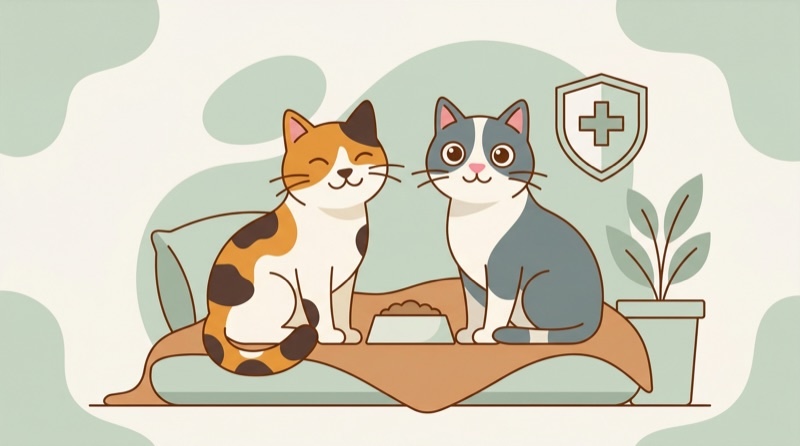
In most cases, yes. When cats get along and don’t fight, the risk of passing FIV between them is low. Hissing or the occasional swat doesn’t count. What spreads it is a deep bite, so if your cats regularly fight hard enough to wound each other, the risk is much higher.
How common is it?
Worldwide, about 1 in 11 cats that get tested are FIV-positive. Cats brought in for testing aren’t typical pets, though, and indoor-only cats have very low infection rates.
Outdoor cats and strays are the most likely to be infected. Males are about 2.5 times more likely to test positive than females, and adults about 2.8 times more likely than kittens.
Testing
FIV is usually checked with a quick blood test at the clinic, with results in minutes. The test looks for antibodies the body makes against FIV, not for the virus itself. It’s very accurate: it picks up about 98% of infected cats and rarely gives a false alarm.
Get your cat tested:
- When you bring a new cat home
- After contact with a cat whose status is unknown
- Before vaccinations
- When your cat is sick
A positive result needs a second test
Indoor-only cats with no bite wounds are rarely infected, so a positive quick test should be confirmed with a different test, such as Western blot or IFA. PCR is sometimes used too, but it isn’t always reliable and can be wrong in either direction.
When a kitten tests positive
Kittens born to FIV-positive mothers pick up their mother’s antibodies through her milk, so they can test positive even when they aren’t infected. These antibodies usually fade by 12 to 16 weeks of age, sometimes later.
If a kitten under 6 months tests positive, retest every 60 days until the kitten is at least 6 months old. A positive result after 6 months confirms a real infection.
The stages of FIV
FIV goes through three stages, and many cats never reach the last one.
Acute stage (weeks to months after infection). Lymph nodes may swell, and the cat may run a mild fever or seem tired. This passes on its own, and most owners never notice it.
Asymptomatic stage. Most FIV-positive cats spend most of their lives here. The virus slowly builds up in the body while the cat looks healthy and acts normally. This stage can last for years, and some cats stay in it for life.
Immunodeficiency stage. Once the immune system is badly damaged, the cat picks up infections easily and becomes prone to other illnesses. By this point, the time from falling ill to death is usually a matter of months.
How long do FIV-positive cats live?
Many FIV-positive cats live as long as any other cat. As long as a cat isn’t also infected with FeLV, FIV usually doesn’t shorten its life, so a positive test on its own is no reason to consider euthanasia.
Cats infected with both FIV and FeLV do much worse and may survive only a few months, which is why it’s worth testing for both.
Problems FIV can cause
The most common trouble spot in FIV-positive cats is the mouth, especially long-lasting, severe inflammation of the gums and mouth (chronic gingivostomatitis). As immunity weakens, other problems can show up:
- Cold symptoms that won’t clear up or keep coming back
- Skin infections
- Weight loss
- Chronic diarrhea
- Eye inflammation
- Anemia or low white blood cell counts
- Lymphoma and other cancers
None of these is certain to happen, and regular checkups can catch them early.
Caring for an FIV-positive cat at home
There’s no cure for FIV and no medicine made specifically for it. Care comes down to keeping the cat healthy and catching problems early.
Keep them indoors. Your cat stays away from germs outside and can’t pass the virus to cats in the neighborhood. Spaying or neutering also cuts down the urge to roam and fight.
Look after the teeth and mouth. Keep up with regular dental checkups and cleanings.
Get a checkup every six months, including blood and urine tests. Weigh your cat regularly at home too. Weight loss is often the first warning sign.
Feed complete food, nothing raw. Skip raw meat, raw eggs, and unpasteurized dairy. A cat with weaker immunity is more likely to get sick from them.
Keep stress down. Long-term stress weakens immunity. A steady routine, enough litter boxes and resting spots, and few sudden changes at home all help. It’s also worth learning the signs of stress in cats.
Keep up with vaccines. A cat with weaker immunity needs the protection of core vaccines even more. Your vet can help you work out when each one is due.
See the vet early when they’re sick, instead of waiting to see. An infection an ordinary cat would shake off can turn serious quickly in an FIV-positive cat.
The FIV vaccine
The FIV vaccine has been discontinued in the US and Canada. It’s still available in Australia and New Zealand.
Vaccinated cats carry antibodies that can last 7 years or more. A quick test later on may come back positive, and the result alone can’t tell vaccination apart from real infection.
Protection is limited too, at about 56% in Australia, and FIV specialists almost all advise against it.
Adopting, or living with other cats
Adopting an FIV-positive cat is fine. They need much the same care as any other cat. If you already have cats, first see whether they get along and whether they fight.
If one cat in your home tests positive, there’s no need to rush to separate them. Your vet can help you decide how to set things up.
Frequently Asked Questions
Is FIV a death sentence for cats? No. Many FIV-positive cats live as long as any other cat. As long as a cat isn’t also infected with FeLV, FIV usually doesn’t shorten its life.
Can FIV-positive cats live with other cats? In most cases, yes. FIV spreads mainly through deep bite wounds from fighting, and sharing bowls or a litter box or grooming each other usually doesn’t spread it. When cats get along and don’t fight, the risk of living together is low.
Can FIV spread to humans? No. FIV only infects cats and can’t spread to people or dogs. Living with, holding, and petting a positive cat has no effect on your family’s health.
How is FIV in cats diagnosed? With a quick blood test at the clinic, with results in minutes. A positive result in an indoor-only cat with no bite wounds should be confirmed with a different test. Kittens under 6 months can test positive because of antibodies from their mother’s milk, so retest every 60 days until the kitten is at least 6 months old.
References
- Little, S., Levy, J., Hartmann, K., Hofmann-Lehmann, R., Hosie, M., Olah, G., & St Denis, K. (2020). 2020 AAFP Feline Retrovirus Testing and Management Guidelines. Journal of Feline Medicine and Surgery, 22(1), 5-30.
- Cornell University College of Veterinary Medicine. (2024). Feline Immunodeficiency Virus (FIV). Cornell Feline Health Center
- Bezerra, J. A. B., et al. (2024). Global seroprevalence and factors associated with seropositivity for FIV. Preventive Veterinary Medicine, 231, 106315.
- Nehring, M., Dickmann, E. M., Billington, K., & VandeWoude, S. (2024). Study of FIV prevalence and expert opinions on standards of care. Journal of Feline Medicine and Surgery, 26(7).
- Murphy, B. G., et al. (2023). The Late Asymptomatic and Terminal Immunodeficiency Phases in Experimentally FIV-Infected Cats. Viruses, 15(8).
- Litster, A. L. (2014). Transmission of FIV among cohabiting cats in two cat rescue shelters. Veterinary Journal, 201(2), 184-188.
- Spada, E., et al. (2018). Survival time and effect of selected predictor variables in cats with feline immunodeficiency virus and feline leukemia virus. Preventive Veterinary Medicine, 152, 39-47.
- Ravi, M., et al. (2010). Naturally acquired feline immunodeficiency virus (FIV) infection in cats from western Canada: prevalence, disease associations, and survival analysis. Canadian Veterinary Journal, 51(3), 271-276.
- Soltero-Rivera, M., et al. (2023). Feline chronic gingivostomatitis: current concepts. Journal of Feline Medicine and Surgery, 25(7).
- Hartmann, K. (2017). Performance of 4 Point-of-Care Screening Tests for Feline Immunodeficiency Virus and Feline Leukemia Virus. Journal of Veterinary Internal Medicine, 31(3).
- Westman, M. E., et al. (2022). FIV infection in domestic pet cats in Australia and New Zealand: guidelines for diagnosis, management, and control. Australian Veterinary Journal, 100(8), 345-359.